My daughter (now 21) has always been obsessed with animals and has never known a time in her life when she hasn’t had pets. She, together with her two brothers, grew up with two Labrador dogs, an array of moggies, pet rats and is now the proud owner of a corn-snake called Charlie and a hamster called Eric. The great benefits of pet ownership for all children are well-known, but these benefits became even more significant for our daughter when she was diagnosed with Asperger’s Syndrome at the age of 18.
Asperger’s Syndrome is an autistic spectrum disorder (‘ASD’), a ‘hidden disability’, which makes it harder for my daughter to make sense of her world, process information and interact and communicate with others, even though she is an articulate and intelligent young woman. This creates a huge amount of pressure for her when trying to fit in with her peers and relate to them, causing her to experience a high level of social anxiety and, in turn, emotional exhaustion.

Willow in a Basket
(c) copyright Sherri Matthews 2013
Of course, we didn’t know any of this when she was growing up, but even then we noticed how she would turn to Willow, our gorgeous, saggy old ‘Bagpuss’ of a cat, scooping her up in her arms as she happily let my daughter cry and rub her face into her furry tummy when she was having one of her childhood ‘melt downs’.
I am not so sure that Willow would have allowed any of us to have done the same!
Being able to ‘talk’ to her pets was/is very therapeutic and calming for my daughter, helping her a great deal with her particular kind of stress. As she explains it, she relates better to her pets than to other people because she can sense their needs and understand them and she doesn’t feel the pressure or stress of human relationships.
The love she has for her pets, particularly her cats, and the love she receives back from them has been a steadying force of peace and security in her sometimes chaotic ‘Aspie’ way of life. They provide comfort, love and interaction without the expectation for her to say and do the right things. Nothing is expected of her, there is no pressure to ‘fit in’, she isn’t being judged, she can be herself, and relate to them in love, by cuddling and showing emotion, where otherwise this can be difficult for Aspies.
Professor Tony Attwood, a psychologist and one of the world’s leading experts on ASD has written extensively about Asperger’s Syndrome. In his forward for Liane Holliday Willey’s book ‘Safety Skills for Asperger Women: How to save a Pefectly Good Female Life’, he describes the many challenges specific to girls and women with Asperger’s, in particular their need to ‘escape’ and makes this telling observation:
“Another escape is into the exciting world of nature, having an intuitive understanding of animals, not people. Animals become loyal friends, eager to see and be with you, with her feeling safe from being teased or rejected and appreciated by her animal friends.”

Two Young Chicks!
(c) copyright Sherri Matthews 2013
There seems to be a unique chemistry between people on the autistic spectrum and animals. Certainly, I witnessed this many times with my daughter. We raised chickens once and we were amazed at how she would let day old chicks sit on her shoulder as she hand-fed them, then watch as they would fall asleep right there nestled up to her neck, feeling perfectly safe.
This chemistry, together with the calming effect that a dog brings to an autistic child when anxious or distressed, has been observed by PAWS (Parents Autism Workshops and Support), an innovative charity set up by Dogs for the Disabled and based in Banbury, Oxfordshire. PAWS has developed the training of assistance dogs to work effectively with both children with autism and their parents and carers. They do also recognise that a well-trained pet dog can be just as beneficial.
The well-known American Temple Grandin is an autistic woman who was incorrectly diagnosed as brain-damaged and developmentally disabled as a very young child and as such, faced many difficult challenges growing up. However, she went on to become a professor at Colorado State University and is now a leading animal behaviour expert and consultant to the livestock industry (source credit: Wikipedia).
As a truly inspirational autistic activist and best-selling author, she tells of her love for horses and how a completely unexpected turning point in her life changed everything for her; while looking after horses at her sister-in-law’s ranch, she began to thrive. She then discovered that she had a special bond with the cattle also at the ranch, in whose company she felt more peaceful than with people.*
The extremely important value of animals and pets in the lives of those on the autistic spectrum cannot be denied. Finally, and to end on a light-hearted note, in talking to my daughter as research for the purposes of this article, she came up with several similarities between her ‘Aspieness’ and our cats, which I share here:
1. Cats are nocturnal. So is my daughter.
2. Cats like to be touched but only on their terms, otherwise don’t you dare. Just like my daughter.
3. Cats are very picky about their food. Hmmmmm……just like my daughter.
4. Cats have major sensory issues – too loud, too hot, too cold, too many people. Same with my daughter.
5. Cats detest changes to their routine, it actually makes them ill and retreat. My daughter has to do things her way and in her time. She can retreat into her room, in the dark, for days on end.
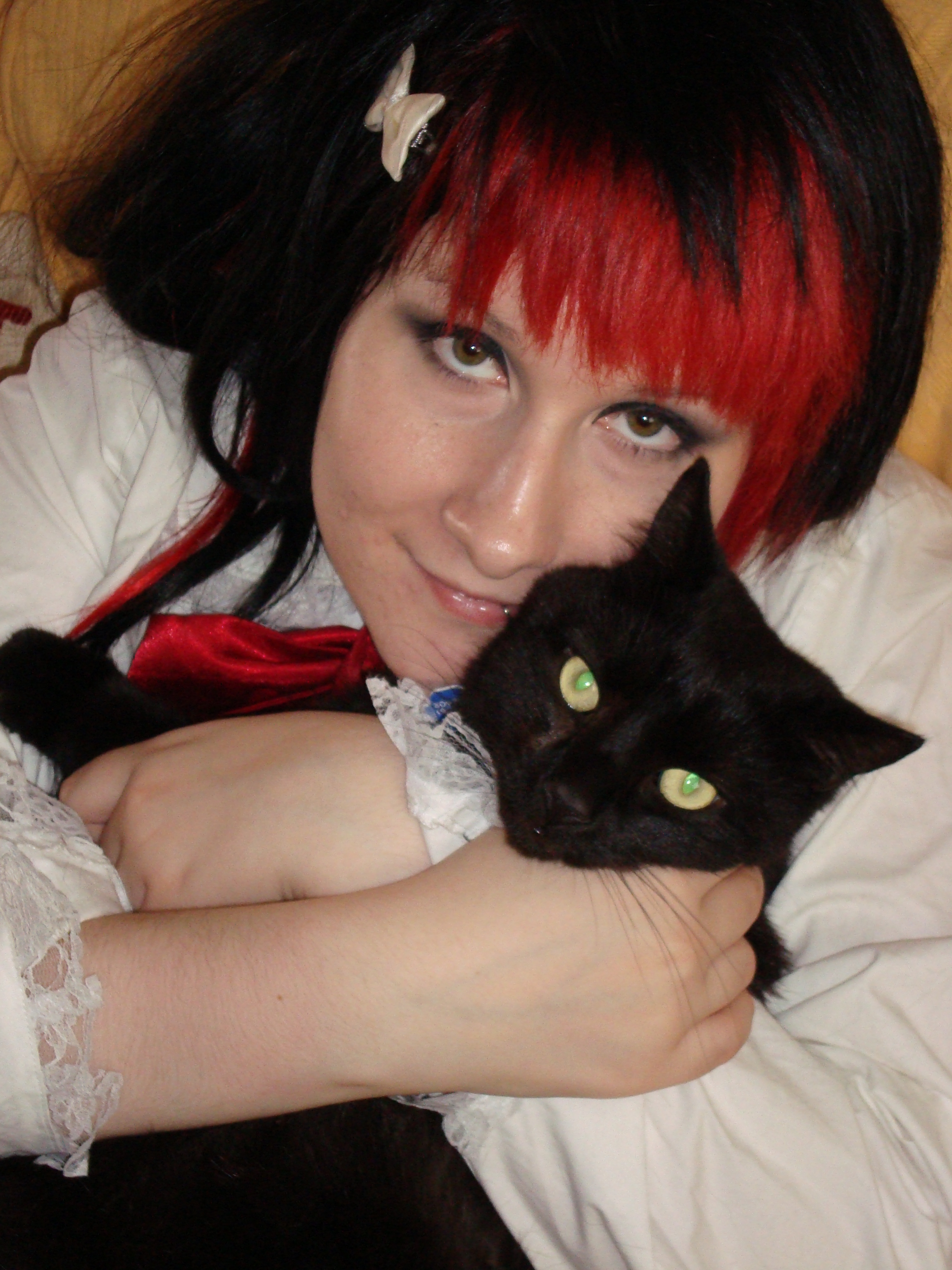
My ‘Little Asp’ with our moggie Eddie 2009
(c) copyright Sherri Matthews 2013
6. Cats will only come to you if they trust you and feel safe with you, then they will show their cuddly, purry love in the most wonderful way. Otherwise it’s the cold shoulder.
My daughter is honest to the point of bluntness which can seem rude to others but this is a common Asperger trait. There is no side to her and she shows her love in her own wonderful way.
So then, my daughter continues to be obsessed with animals and in her ideal Aspie world she thinks it would be wonderful if she could also have, in no particular order:
A Rottweiler, a racoon, a crow and a Peach-Faced Lovebird.
Safe to say she will have a long wait but her cats are always close to hand should she need a lovely soft, purry cuddle.
(c) copyright Sherri Matthews 2013
Related links for further information:
Safety Skills for Asperger Women: How to Save a Perfectly Good Female Life -Liane Holliday Willey, Jessica Kingsley Publications, £11.69 Amazon
National Autistic Society’s website: http://www.autism.org.uk





































 A View From My Summerhouse
I just learned my wife (30) is autistic and on the spectrum closer to what was called aspergers. I found this post very helpful as through the years my wife has adopted many pets and it has been a Financial strain.
LikeLike
Tim, I am heartened this post was helpful to you. More and more, adults on the spectrum are being diagnosed later in life. The more we know, the better. All the best to you and your wife. Sherri
LikeLike