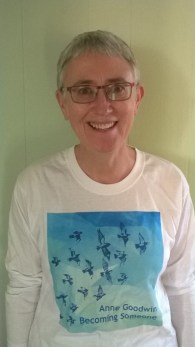
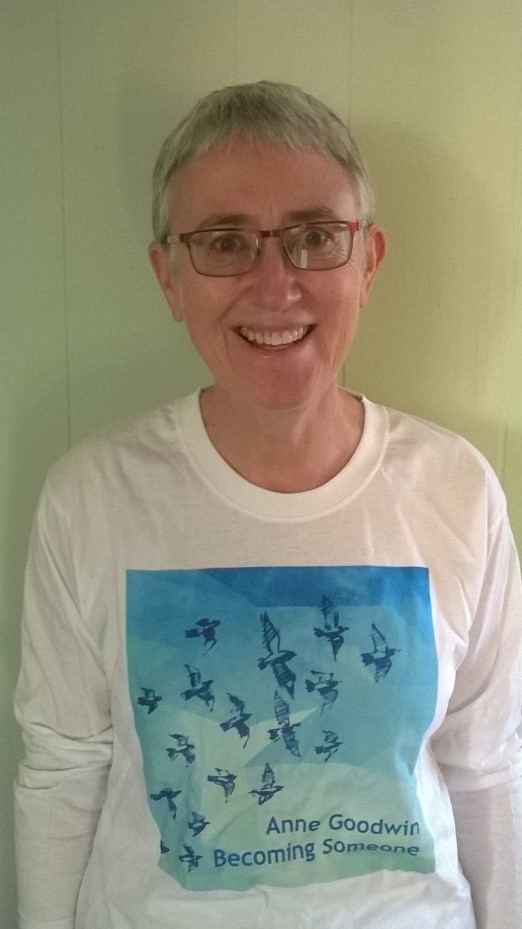
 Today, I’m delighted and honoured to host author Anne Goodwin at the Summerhouse for her ongoing blog tour.
It’s lovely to welcome Anne again, so much enjoying her engaging and much discussed guest post, ‘Putting the personal into fiction…and taking it out again‘ three years ago (yes, that long…!).
Since then, Anne has published two novels (see her bio below). Her latest publication, ‘Becoming Someone‘,
an anthology of 42 short stories, launches on
23rd November.
Anne’s stories explore the very different ways we view ourselves, asking, ‘Is identity a given or can we choose the someone we become?’ (See Blurb below.)
As a mother of an adult child with Asperger’s Syndrome, this is a subject close to my heart, as discussed in my Raw Lit post over at Carrot Ranch in March, ‘Asperger’s, Voice And The Search For Identity.’
Anne’s guest post explores another subject close to my heart, and many of us reading I’m sure, as she delves into the complexity of a writer’s struggle with identity:
Don’t let your fears prevent you from embracing your identity as a writer
You write, so you’re a writer, right? Yet many of us struggle to embrace that concept, and not only because it twists the tongue if we try to say it fast out loud. Somehow we’ve built up such highfalutin fantasies of what a writer actually is we feel a fraud to claim that identity for ourselves. There’s often a sense we don’t deserve that title unless we’re exceptionally good at it, but is that logical? Think of government ministers lurching from one crisis to another: do they shy away from declaring themselves politicians merely because they don’t shine at the job? Of course not. Nor do they seem to pay much attention to how others judge them, given the level of criticism required to shame them into resignation.
The fear of feeling a fraud
Sometimes, however, knowing our assumptions aren’t rational isn’t enough to shrug them off. In my previous identity a psychologist, I learnt to do detective work on dysfunctional beliefs, excavating their origins and the fantasies that shore them up. Often, it helps to revisit our childhoods to explore how our unhelpful attitudes first arose.
Were your parents especially critical, looking out for behaviours to criticise instead of things to praise? That was certainly the case for me, and for many of my generation. (Although the current tendency towards excessive validation can also be damaging if children get the message it makes no difference what they do.)
Hard-to-please parents can set an overly ambitious standard of what’s acceptable, with no sense of good-enough. Maybe they didn’t intend to, maybe we didn’t mean to internalise the message, but it’s there when, at the end of a writing session, we can’t congratulate ourselves for getting the words on-screen or paper because those words are flawed.
As a child, what did you think writer was and did you dare imagine becoming one? Scribbling stories from almost the moment I could shape my letters, I think that, deep down, I always wanted to be a writer, although I’d never have articulated it, not even to myself. In fact, it was hard for me to summon any kind of ambition other than pleasing my parents, but it wasn’t only that. Writers were a breed apart from the adults in the working-class community that raised me. I’d have as much imagined being a writer as going into politics, and I had no notion of that.
When, in middle age, I admitted I wanted to write, it still felt audacious. The only writers I knew of were the successful ones whose hardback novels graced the windows of bookshops and were reviewed by other famous authors in the literary supplements at weekends. No wonder it took me so long to take my literary interest seriously with the barrier set so high.
Now, with two published novels and a short story anthology on the way, I’m definitely more confident in my identity as a writer. Nevertheless, published by a micro press no-one has heard of, there’s still a part of me that feels I’ve failed. If we’re prone to self-disparagement, that’s something every writer has to live with. In our hyper-connected world, we’re constantly reminded of the myriad things we haven’t achieved. Something else I take from my career as a psychologist – although don’t heed my own advice as much as I ought to – is that, as in any emotionally-demanding job, we need to take care of ourselves, to celebrate the small successes and to mourn our writerly disappointments too.
The fear of others’ negativity
If it wasn’t tough enough to embrace our identities as writers for ourselves, we have other people’s attitudes to contend with. Of course, we shouldn’t care what others think, but most of us do. Especially those of us who’ve imbibed criticism with our mothers’ milk. But there are things we can do to ensure that others’ negativity doesn’t cancel out our treasured identities altogether.
The first is obvious, but not necessarily easy to implement. We need to surround ourselves with people who do accept our legitimacy as writers and, where we can, shed those relationships that don’t. If it’s taken you time, as it did for me, to emerge as a writer, those close to you might also need time to adjust. But if they don’t adjust, and continue to undermine you, would you have the courage to let them go? Ah, but my mother/husband/sister doesn’t intend to hurt me, you might protest. But if you’ve tried to explain what it means to you and they still don’t listen? Their failure to support you could be symptomatic of a more general absence of respect. Unravelling ourselves from dysfunctional relationships can be complex and painful, but perhaps a necessary step towards becoming the person we want to be.
On the other hand, we need to guard against being so sensitive we detect slights that aren’t there. Sometimes, the negativity we perceive in others is actually a projection of the fraudulence we fear ourselves. Or it could be that an individual doesn’t recognise you as a real writer because of their misguided fantasies about what being a writer means. Is it easier to deal with if you can attribute it to lack of knowledge? Some people can’t resist attaching the adjective famous to the word author, perhaps even rich and famous in their heads. By responding with facts, rather than defensively, you might transform them into one of your supporters. You might, by example, encourage them to follow their dreams.
Although not all writers are published, most of us want our words to be read. Which inevitably means they’ll be judged, if we’re lucky, by people we never meet. Sensitive souls that we are, many of us feel diminished by a negative review. With practice, we can use this as a cue to take care of ourselves and also, as I found with my first one-star review on the eve of publication of my second novel, a reminder that tastes differ and we can’t please everyone.
It’s all material!
Remember too that everything’s material: our doubts and disappointments can be ploughed into our writing, contributing to an emotional depth. In my short story collection on the subject of identity, you might recognise some of the issues outlined in my characters’ narrative arcs. But it’s not swarming with writers, far from it: there’s only one young woman claiming the right to tell her story in her own individual way.
The theme’s evident in the mediaeval nun who retreats from her creativity and in the prize-winning physicist who can’t decide what to wear. It’s there in the woman with a worn-out marriage who discovers good-enough and in the overworked doctor who conjures up an alter ego to give himself a break. It’s echoed in the woman whose nearest-and-dearest thinks she’s crazy to adopt a more frugal lifestyle and in the young man telling his parents some uncomfortable and unexpected truths. Perhaps, if you do me the honour of reading the anthology you’ll identify other connections too.
*********
Thank you so much, Anne, for shedding your fascinating insight on this subject which I, and I’m sure most writers, relate to. It took me a long time to say with purpose, ‘I am a writer.’ You indeed inspire us to be the someone we should be.
‘Becoming Someone’ is published 23rd November by Inspired Quill
Many Congratulations, Anne!
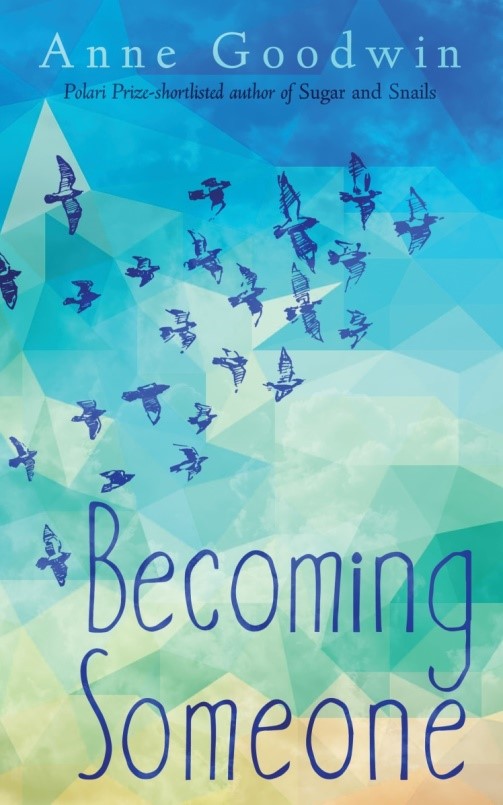
Becoming Someone blurb
What shapes the way we see ourselves?
An administrator is forced into early retirement; a busy doctor needs a break. A girl discovers her sexuality; an older man explores a new direction for his. An estate agent seeks adventure beyond marriage; a photojournalist retreats from an overwhelming world. A woman reduces her carbon footprint; a woman embarks on a transatlantic affair. A widow refuses to let her past trauma become public property; another marks her husband’s passing in style.
Thought-provoking, playful and poignant, these 42 short stories address identity from different angles, examining the characters’ sense of self at various points in their lives. What does it mean to be a partner, parent, child, sibling, friend? How important is work, culture, race, religion, nationality, class? Does our body, sexuality, gender or age determine who we are?
Is identity a given or can we choose the someone we become?
*******
Anne Goodwin’s debut novel, Sugar and Snails was shortlisted for the 2016 Polari First Book Prize. Her second novel, Underneath, was published in 2017. Her short story collection, Becoming Someone, on the theme of identity launches on Facebook on November 23rd, 2018, where the more people participate the more she’ll donate to Book Aid International. A former clinical psychologist, Anne is also a book blogger with a particular interest in fictional therapists.
You can connect with Anne here:
Website: annegoodwin.weebly.com
Twitter @Annecdotist
Amazon author page
Author page at Inspired Quill publishers
*******
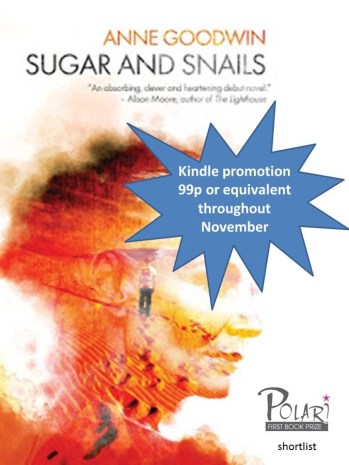
And just in time for Christmas… Sugar and Snails promotion Anne’s debut novel is discounted to 99p or equivalent (Kindle version) throughout November viewbook.at/SugarandSnails
*******
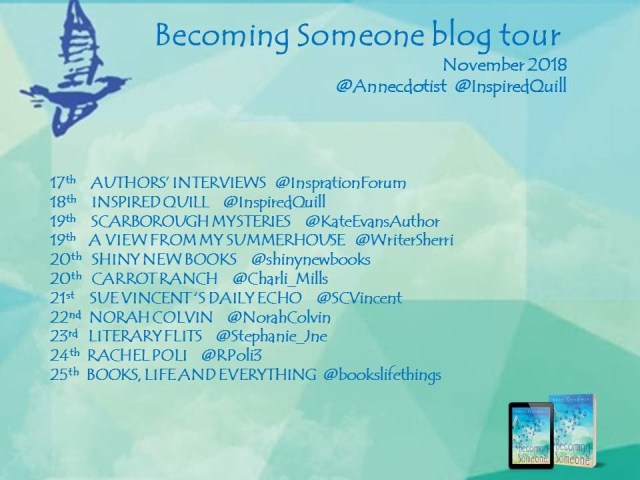
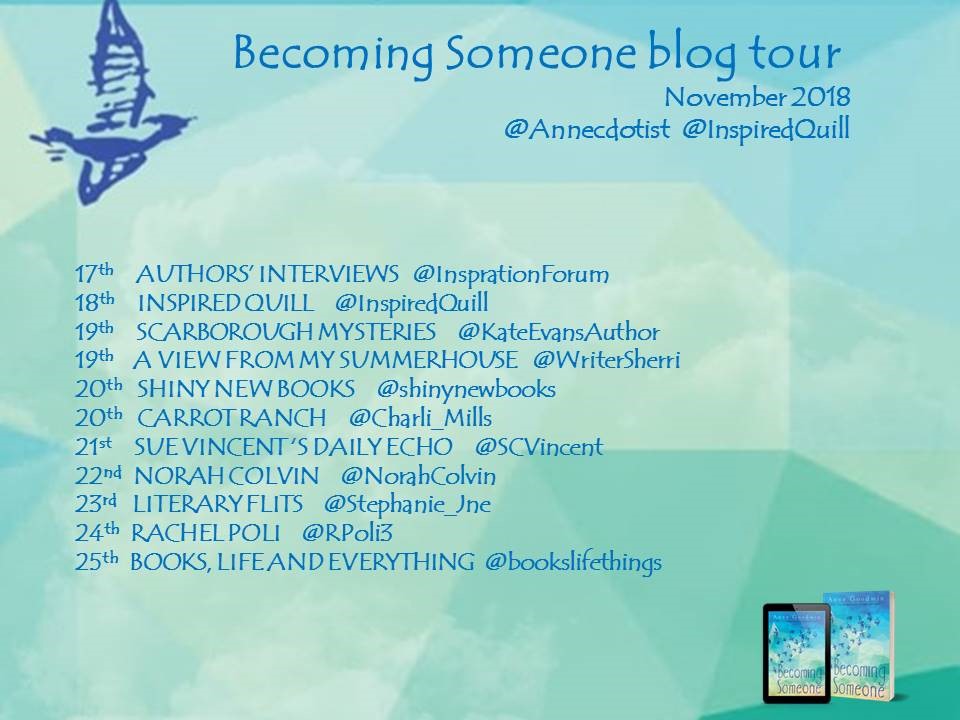
Follow Anne on her ‘Becoming Someone’ blog tour trail
for more updates and guest posts!
 Or a cabin in the mountains just five minutes away.

 But do not fear. All is not lost.


































 A View From My Summerhouse