
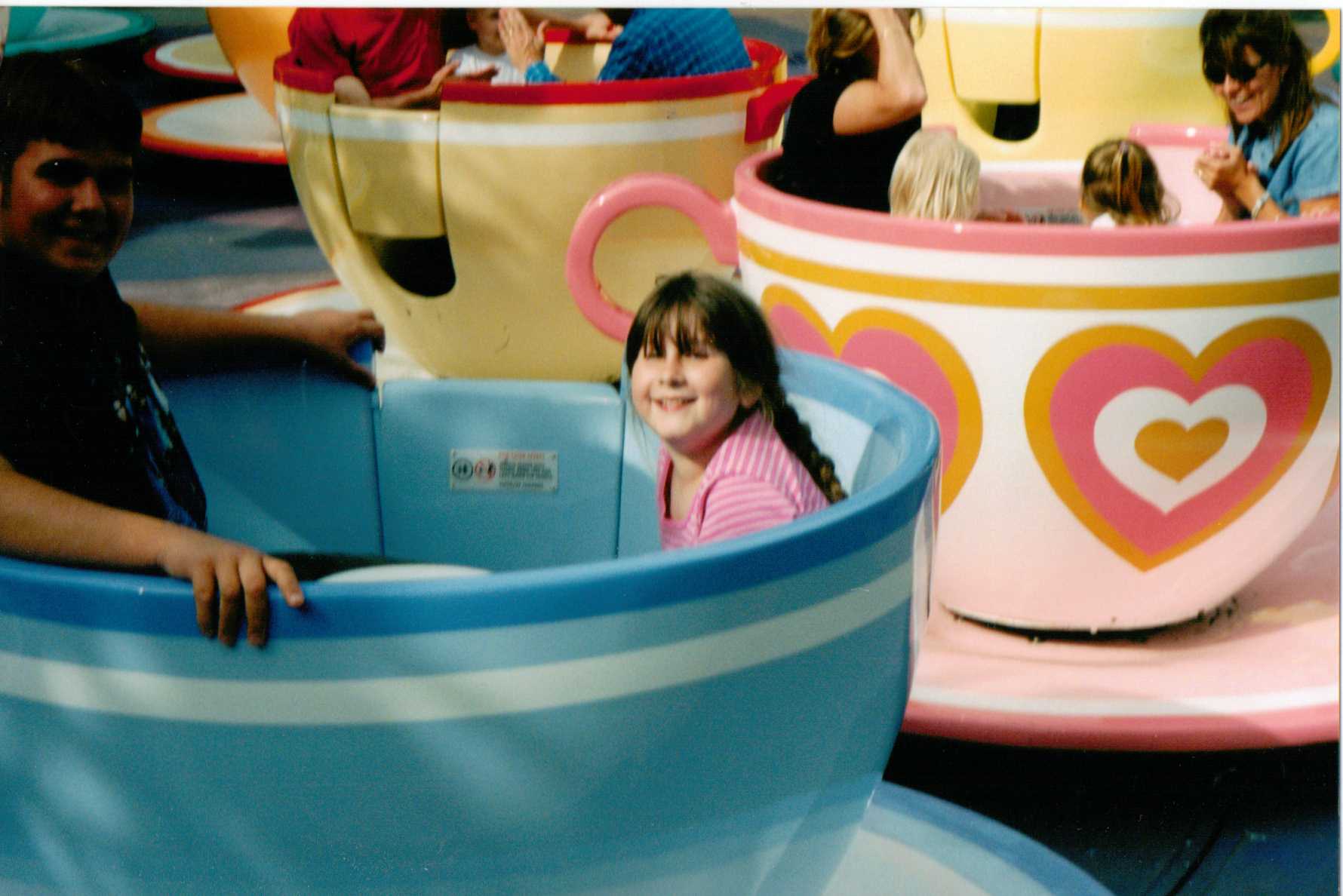
My daughter and big brother on the Teacups at Disneyland 1990s
(c) Sherri Matthews 2104)
The taste of LA on a Disneyland morning.
It is the taste of hot coffee, Winchell’s donuts and egg and bacon breakfast sandwiches.
This is what was brought to Aspie Daughter’s mind as we chatted one day about the times when she was little and we used to go to Disneyland when we lived in California.
I also knew just what she meant in remembering when we first arrived at LAX after a long-haul flight walking out into the warm, open air feeling exhausted yet exhilarated, of being hit in the face by the smell of French fries tinged with the fumes of gasoline. You could almost taste it.
Except that she actually did ‘taste’ it.
Over the years I’ve always been intrigued by the way Aspie Daughter told me how she could ‘taste’ and ‘see’ words in colour. I thought it was part of her unique creativity and that it was just one of her many creative and special little ways.
Then, last summer (and once again, thank you ‘spamgate’!) I met my lovely friend Jenny over at her beautifully written blog Characters From The Kitchen. Since then, we have shared many stories from our childhoods, put the world to rights and laughed so hard until my hotpants sides have split in two.
Reading her ‘About’ page, I was astounded to learn the unique way she ‘sees’ numbers as colours and that this is an actual condition called ‘synaesthesia’. Hence started a very lively discussion between us about this fascinating subject because I realised that Aspie Daughter must have some form of it. My interest grew even more when I read Jenny’s post about this very subject.
Then I wondered if it was more common in people with Asperger’s Syndrome and perhaps an extension of an already heightened, every day sensory experience.
Before I go on, I should clarify here that I am making a distinction between Asperger’s Syndrome and full-blown Autism even though they are both classed as an Autistic Spectrum Disorder (ASD).
Some of you may already know that last May, the American Psychiatric Association adopted new guidelines with its official release of the DSM-5 (The Diagnostic and Statistical Manual of Mental Disorders, Fifth Edition) meaning that previously recognised sub-types of ASD (including Asperger’s Syndrome) are now put into one diagnosis of ASD.
This redefinition of Asperger’s has been hotly debated and I will be writing more about this very lengthy subject in due course, but you can click here for further information in the meantime.
However, and referring to a study done last year using brain-activity monitoring, research seems to back up the idea that Asperger’s is a distinct form of autism. For instance, although those with Asperger’s and Autism both have difficulty with social interaction and restricted, obsessive interest, those with Asperger’s (also known as Higher Functioning Autism) have typical or even advanced language development and intellect.
Coming back then to synaesthesia. What exactly is it? The UK Synaesthesia Association asks this on its website:
‘What colour is the letter “A”? What does the number ‘1″ taste of? Does listening to music, speaking or eating food produce colours, shape or texture? For most people, questions such as these will either yield a look of bewilderment or an emphatic “No!”‘
Quite simply, for those with this ‘condition’ the answers to the questions above would be very different!
A BBC News health report written last November highlighted a new study linking synaesthesia with autism which was carried out by the Autism Research Centre at Cambridge University. They discovered that synaesthesia is three times more common in people on the autistic spectrum, including those with Asperger’s.
What I find so fascinating about all this is that this study seems to point to similarities in underlying and unusual brain connectivity with ASD and synaesthesia. When I consider that sensory issues play a huge part in ASD, and that synaesthesia seems to be a mixing-up of the senses due to anomalies in the way the brain is wired, I am very excited to learn more about this intriguing subject as more research takes place.
To end this article, and as promised, I persuaded my lovely Aspie Daughter (and she very kindly agreed) to interview her as I thought it would be good for her to share her personal experiences with synaesthesia. I hope you will find her answers just as interesting and as enlightening as I did! Since it is one of her favourite colours, her answers are in green!
1. When did you first hear the word ‘Synaesthesia’ and in what context?
When you told me about the blog post you read about it, I immediately recognised something in it that seemed familiar to my experience. I had never heard the word until then or knew nothing about the condition.
2. When I explained to you what it was, in general terms, what were your thoughts?
I didn’t realise that it was a ‘condition’. I thought it happened to everyone and that it was normal.
3. Does this mean that you have been aware of having it all your life?
Yes. I noticed that I ‘tasted’ different, random words and saw words in colour but I never thought it was any different to anyone else or weird. I thought it was normal.
4. When you say you ‘taste’ random words, can you describe this for us?
Well, for instance, when I hear, read or speak the word ‘group’ I taste vanilla pudding. It’s not a literal taste, it’s more that my taste buds are remembering the texture and the flavour of the pudding but it’s not like I’m putting the food literally in my mouth. I would call it a weak taste, but it happens every time.
5. Can you give me some more examples of random word/taste association?
Yes, the word ‘tomorrow’ I always associate with baby carrots, the word ‘wood’ gives me the taste and scent of fresh water, as in a river. ‘Clock’ tastes of cheesy-rice.
6. What about colours that you see with days of the week?
Thursday I see dark blue, Wednesday is orange, Tuesday is like a cornflower blue, Monday is maroon, Friday is lilac, Saturday is dark green and Sunday is yellow.
7. This leads me to my next question. Do you think that the way you ‘see’ days of the week as colours ties in with the way certain colours make you feel calmer or more stressed?
I think the way they are is because maybe when I was younger I may have seen some sort of calendar or something with days of the week which has stayed in my mind. I don’t like yellow very much and I don’t like Sundays. I remember in California not liking waking up on a Sunday morning with it being very bright and sunny and everyone being up already, making noise around the house because it made me feel tense and anxious. Because the school week was so long and stressful for me I wanted to spend the weekend relaxing and sleeping in. This only happened on Sundays, I was fine getting up on Saturdays. So yellow, which I associate with the sun which I don’t like, is probably why I think of Sundays in this colour.
8. You always struck me from a girl how you phrased words in such a descriptive way. For instance, one morning when we went outside and it was cold and damp and you said it ‘smelled like dirty frogs’. You also said that beer ‘smelled like liquid bread’. You were only about four or five (quite why you were smelling beer I don’t know!) and you had no idea that it is made from hops, and that yeast is used to make bread.
* Laughing * Yes, I remember that!
9. All in all, now that you know that your unique way of seeing and tasting words in colour is quite unusual and an actual condition, how do you feel about that?
Fine, it is just there. It doesn’t affect me one way or the other.
10. Thank you lovely daughter! How would you feel about doing another interview some time?
That’s ok. Maybe! *Smiles*
There you have it! I hope you enjoyed my first blog interview with Aspie Daughter. I happen to think she is pretty amazing, but then I would since I’m Mum so I’m biased, naturally.
Have a great weekend everyone and keep warm and dry, or cool, depending on which side of the planet you’re on, and I will do my best to catch up with you in the next couple of days 🙂


















































 A View From My Summerhouse